Article Outline:
- Introduction: Understanding FDY Polyester Filament in Modern Textiles
- Brief overview of Fully Drawn Yarn (FDY) in the global market
- Importance of elasticity for manufacturers and end-users
- What is FDY Polyester Filament?
- Definition and production process (spin-draw process)
- Key differences from POY and DTY in terms of structure
- Elasticity of FDY Polyester Filament: A Technical Deep Dive
- Molecular structure and orientation
- Factors influencing elasticity (draw ratio, heat setting, denier)
- Comparison with other polyester yarns and natural fibers
- Quantifying Elasticity: Test Methods and Standards
- ASTM D3107, ISO 2062, and other relevant standards
- Key parameters: elongation at break, elastic recovery, modulus
- Elasticity Data and Performance Metrics
- Table: Elastic properties of FDY vs. other yarns
- Table: Effect of denier and filament count on elasticity
- Case study: Stress-strain curves for different FDY types
- Applications: Where FDY’s Elasticity Matters Most
- Apparel (sportswear, lingerie, linings)
- Home textiles (curtains, upholstery, carpets)
- Technical textiles (seat belts, industrial fabrics)
- Toys and plush manufacturing
- Improving Elasticity: Production Techniques and Finishing
- Draw ratio optimization
- Heat setting conditions
- Blending with elastic fibers (e.g., spandex)
- Chemical and mechanical finishing processes
- Cost-Benefit Analysis: Elasticity vs. Other Properties
- Table: Cost implications of high-elasticity FDY
- Balancing elasticity with strength, dyeability, and shrinkage
- Market Trends and Innovations
- High-elastic FDY for athleisure wear
- Sustainable and recycled FDY with enhanced elasticity
- Smart textiles and shape-memory FDY
- FAQs: Frequently Asked Questions
- 7-10 common questions from buyers and manufacturers
How is the Elasticity of FDY Polyester Filament? A Comprehensive Guide for Textile Professionals
1. Introduction: Understanding FDY Polyester Filament in Modern Textiles
Fully Drawn Yarn (FDY) polyester filament is a cornerstone of today’s textile industry, How is the Elasticity of FDY Polyester Filament? valued for its strength, uniformity, and versatility. With global polyester production exceeding 60 million tons annually, FDY accounts for a significant share, especially in woven and knitted fabrics. For procurement managers, garment manufacturers, carpet producers, and toy makers, understanding the elasticity of FDY is critical—it directly impacts product performance, durability, and end-user satisfaction. This article delves into the technical aspects of FDY elasticity, backed by data and practical insights, to help you make informed sourcing decisions.
2. What is FDY Polyester Filament?
FDY is produced through a continuous spin-draw process, where polyester chips are melted, extruded, and drawn to align polymer chains fully. Unlike Partially Oriented Yarn (POY), which requires further drawing, or Draw Textured Yarn (DTY), which is crimped for stretch, FDY is “fully drawn” and has minimal residual elongation. Its smooth, straight filaments offer high tenacity and dimensional stability, making it ideal for applications where consistent performance is key.
3. Elasticity of FDY Polyester Filament: A Technical Deep Dive
Elasticity refers to a material’s ability to return to its original shape after deformation. For FDY, elasticity is inherently limited due to its highly oriented structure. Key factors include:
- Draw Ratio: Higher draw ratios increase orientation, reducing elongation but improving strength.
- Heat Setting: Stabilizes the structure, affecting elastic recovery.
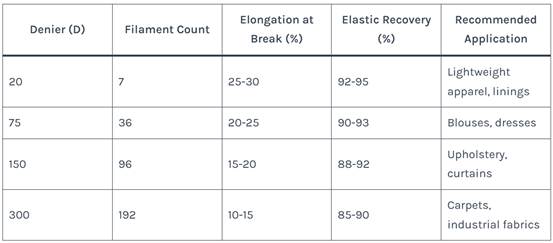
- Denier and Filament Count: Finer deniers (e.g., 20D-75D) offer slightly better elongation than coarse ones (e.g., 300D+).
Compared to DTY (which can have 15-25% elongation) or natural fibers like cotton, FDY typically shows lower elongation at break (10-30%) but excellent recovery in low-stress scenarios.
4. Quantifying Elasticity: Test Methods and Standards
Industry standards ensure consistent measurement:
- ASTM D3107: Elastic modulus and recovery tests.
- ISO 2062: Determination of breaking force and elongation.
- ASTM D1774: Elastic properties of textile fibers.
Critical metrics include: - Elongation at Break: FDY usually ranges from 10% to 30%.
- Elastic Recovery: FDY can recover 90-95% after 5% stretch.
- Initial Modulus: High (50-150 GPa), indicating low initial stretch.
5. Elasticity Data and Performance Metrics
Table 1: Elastic Properties Comparison of Polyester Yarns
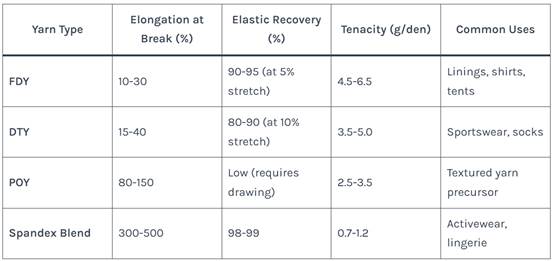
Table 2: Effect of Denier on FDY Elasticity
Case Study: A stress-strain analysis of 75D/36F FDY shows a linear curve up to 10% strain, with near-perfect recovery—making it suitable for applications requiring shape retention.
6. Applications: Where FDY’s Elasticity Matters Most
- Apparel: FDY’s moderate elasticity ensures drape and comfort in linings, blouses, and shirts. In sportswear, it’s often blended with spandex for added stretch.
- Home Textiles: For curtains and upholstery, FDY provides enough give to withstand tension without sagging.
- Carpets: Low elongation (10-15%) prevents pile distortion under heavy traffic.
- Toys and Plush: FDY offers resilience for stuffing and fabric covers, maintaining shape after compression.
7. Improving Elasticity: Production Techniques and Finishing
While FDY’s elasticity is limited, it can be enhanced:
- Optimized Drawing: Adjusting draw ratios (1.5-2.5x) balances strength and elongation.
- Blending: Combining FDY with 5-20% spandex increases stretch to 30-50%.
- Finishing: Softeners and compressive shrinking improve hand feel and recovery.
- Innovative Processes: Bicomponent FDY with elastic cores (e.g., polyether ester) can boost elasticity by 40%.
8. Cost-Benefit Analysis: Elasticity vs. Other Properties
Table 3: Cost Implications of High-Elasticity FDY Modifications
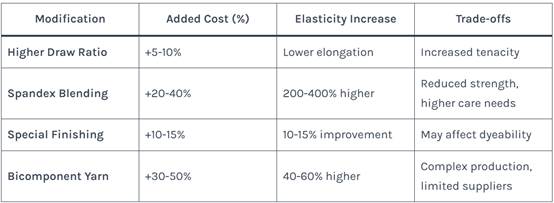
For most manufacturers, blending FDY with spandex offers the best balance for stretch applications.
9. Market Trends and Innovations
- Athleisure Wear: Demand for FDY/spandex blends is growing at 8% annually.
- Sustainability: Recycled PET FDY (from bottles) maintains elasticity while reducing environmental impact.
- Smart Textiles: FDY with conductive fibers for wearable tech requires tailored elasticity.
- Shape-Memory FDY: Emerging polymers that “remember” original shape after deformation.
10. FAQs: Frequently Asked Questions
Q1: Can FDY polyester filament be as elastic as DTY?
A: No, DTY is inherently more elastic due to its crimped structure. FDY offers lower elongation (10-30% vs. 15-40% for DTY) but better shape retention. For high-stretch needs, consider blending FDY with spandex.
Q2: What is the typical elastic recovery of FDY after stretching?
A: FDY recovers 90-95% after a 5% stretch. For example, if a 100 cm FDY fabric is stretched to 105 cm, it will return to approximately 100.5-101 cm.
Q3: How does denier affect FDY elasticity?
A: Finer deniers (e.g., 20D) have higher elongation (25-30%) than coarse deniers (e.g., 300D at 10-15%). See Table 2 for details.
Q4: Is FDY suitable for stretch fabrics like activewear?
A: Not alone—FDY lacks the stretch needed for activewear. However, when blended with 10-20% spandex, it becomes ideal for leggings, sportswear, and lingerie.
Q5: What test methods should I use to check FDY elasticity?
A: Use ASTM D3107 or ISO 2062 to measure elongation at break and elastic recovery. For quality control, test every batch with a standard 5% stretch cycle.
Q6: Does heat setting reduce FDY elasticity?
A: Yes, heat setting stabilizes fibers, lowering elongation by 5-10% but improving dimensional stability. It’s a trade-off based on application needs.
Q7: How does FDY elasticity compare to nylon?
A: Nylon filaments generally have higher elongation (20-35%) and better recovery than FDY. However, FDY is more cost-effective and resistant to UV and moisture.
Q8: Can recycled FDY match the elasticity of virgin FDY?
A: Yes, modern recycled FDY achieves 90-95% of virgin FDY’s elasticity, with elongation differences of less than 3%. It’s a sustainable choice for eco-conscious brands.
Q9: What is the minimum elasticity required for carpet FDY?
A: Carpets need low elongation (10-15%) to resist pile distortion. FDY is preferred for its high tenacity and minimal stretch under load.
Q10: How can I improve FDY elasticity without blending?
A: Optimize the draw ratio during production—lower ratios increase elongation but reduce tenacity. Also, consider softener finishes that enhance fiber mobility.